
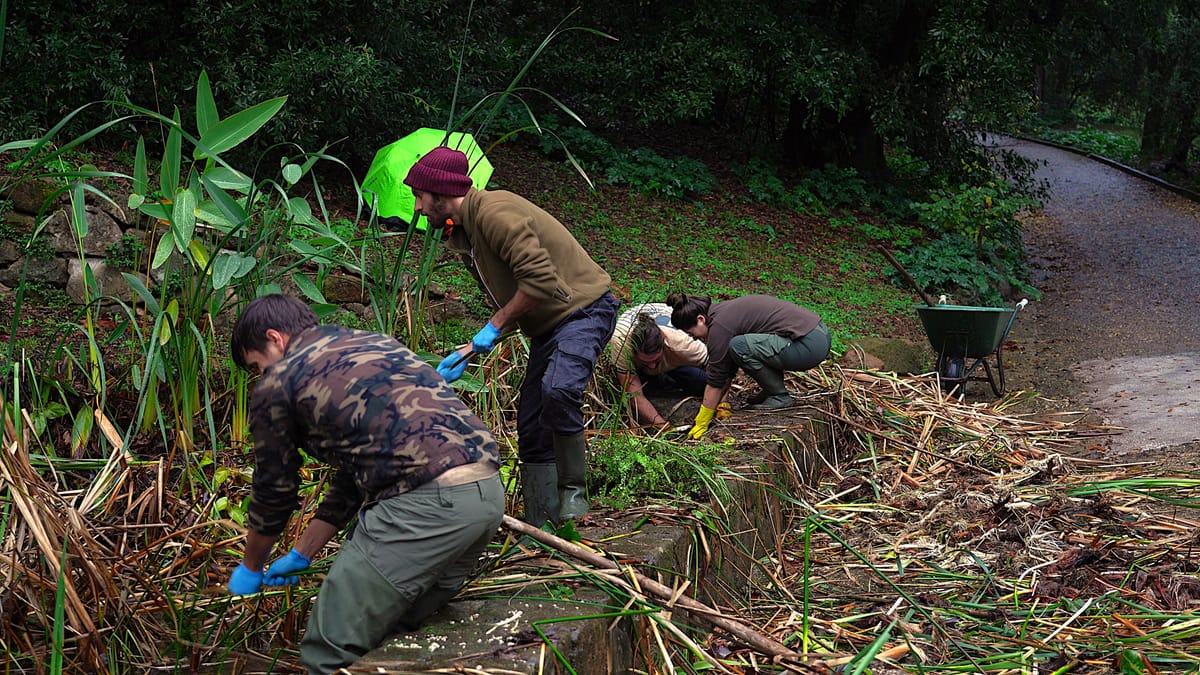
The conservation of biodiversity cannot be limited to theory or simple observation: it requires concrete action, responsible choices and constant commitment in the field. Only through targeted interventions is it possible to restore functionality to ecosystems and guarantee a future for the species that inhabit them. It is with this vision in mind that, as part of the ARCA Project, we are carrying out important work to redevelop the historic ponds and fountains of the Botanical Gardens in Rome, places of great cultural and naturalistic value, but deeply compromised by the presence of alien species such as Gambusia spp. and Trachemys scripta.
During the summer, we carried out a thorough ecological analysis of the sites, calculating the Habitat Suitability Index and the Artificial Water Sites Index for each pond. These tools allowed us to identify critical points and define the most appropriate interventions to maximise the environmental suitability of the ponds and fountains, promoting not only the presence but also the reproductive success of native amphibians.
In late autumn and early winter, we took action: the tanks were emptied, we removed dozens of cubic metres of sludge that had accumulated over time and proceeded to eradicate the invasive species. The non-native turtles were temporarily transferred to a greenhouse in the Botanical Garden, where they do not bother the amphibians. They will subsequently be taken to a collection centre for Trachemys. A particularly interesting result was the recovery, in each pond colonised by non-native species, of a single pedomorphic newt (adults with gills): individuals not detected during spring sampling, confirming that the presence of invasive species prevented presence and reproduction in those tanks. One of the newts found had its tail covered with bites, undoubtedly caused by gambusia or Trachemys.
Another alarming finding concerns the almost total absence of aquatic macroinvertebrates in the ponds we have cleaned up so far, reduced to very few isolated specimens. In many ponds, with the exception of a few gastropods, biodiversity was practically zero. The gambusia, voracious predators, had transformed these environments into veritable biological deserts, depriving them of a fundamental component for the functioning of these fragile environments.
Our restoration work will continue throughout the winter and early spring with the planting of aquatic macrophytes, which are necessary for rebuilding structurally complex and functional habitats. In the absence of non-native predators and with ecological conditions finally favourable, a significant number of amphibians will be able to return to breeding, promoting the recovery of the Lissotriton vulgaris and Bufo bufo populations.
The project is a concrete and easily replicable example of how the redevelopment of small suitable environments, even without resorting to massive investments, can generate tangible benefits for biodiversity conservation. It is an operational model that demonstrates how scientific knowledge, commitment and action can converge to produce real results. A small naturalistic gem in the heart of Rome, to be valued and preserved with care and responsibility.